
A hacker gained access to 100 million Capital One credit card applications and accounts

Posted on
bulldogtech it support

Read Article at CNN Business

New York (CNN Business)
In one of the biggest data breaches ever, a hacker gained access to more than 100 million Capital One customers\’ accounts and credit card applications earlier this year.

Paige Thompson is accused of breaking into a Capital One server and gaining access to 140,000 Social Security numbers, 1 million Canadian Social Insurance numbers and 80,000 bank account numbers, in addition to an undisclosed number of people\’s names, addresses, credit scores, credit limits, balances, and other information, according to the bank and the US Department of Justice.
A criminal complaint says Thompson tried to share the information with others online. The 33-year-old, who lives in Seattle, had previously worked as a tech company software engineer for Amazon (AMZN) Web Services, the cloud hosting company that Capital One was using, the Justice Department said. She was able to gain access by exploiting a misconfigured web application firewall, according to a court filing.
Thompson was arrested Monday in connection with the breach, the Justice Department said. Thompson\’s attorney could not be immediately reached for comment.
 
 
Capital One (COF) said the hack occurred March 22 and 23 and includes credit card applications as far back as 2005. The company indicated it fixed the vulnerability and said it is \”unlikely that the information was used for fraud or disseminated by this individual.\” However, the company is still investigating.
\”I sincerely apologize for the understandable worry this incident must be causing those affected and I am committed to making it right,\” said Capital One CEO Richard Fairbank in a statement.
The breach affected around 100 million people in the United States and about 6 million people in Canada, according to Capital One.
 
However, \”no credit card account numbers or log-in credentials were compromised and over 99% of Social Security numbers were not compromised,\” the company noted.
Capital One said it will notify people affected by the breach and will make free credit monitoring and identity protection available. The company expects to incur between $100 million and $150 million in costs related to the hack, including customer notifications, credit monitoring, tech costs and legal support due to the hack.
Capital One\’s stock was down 5% in premarket trading Tuesday.

How Capital One got hacked

The criminal complaint against Thompson paints a picture of a less-than-careful suspect.
Thompson posted the information on GitHub, using her full first, middle and last name, the complaint says. She also boasted on social media that she had Capital One information.
In a channel on Slack, a chat service often used by businesses as well as other groups, Thompson explained the method she used to break into Capital One, the Justice Department alleges. She claimed to use a special command to extract files in a Capital One directory stored on Amazon\’s servers.
\”I wanna get it off my server that\’s why Im archiving all of it lol,\” Thompson allegedly posted on Slack. One person was alarmed by what Thompson found, writing that the information was \”sketchy,\” adding, \”don\’t go to jail plz.\”
Thompson made little effort to disguise her identity. She allegedly used the screen name \”erratic\” on Slack, which was the same handle she used on a Twitter account and a Meetup chatroom page.
The FBI special agent who investigated Thompson believes Thompson tweeted that she wanted to distribute Social Security numbers along with full names and dates of birth.
One person who saw the information on GitHub notified Capital One of the \”leaked data\” belonging to the company. Capital One notified the FBI, and an agent searched Thompson\’s residence on Monday. They found devices in her possession that reference Capital One and Amazon as well as other entities that may have been targets of attempted — or actual — breaches.
The complaint indicates Thompson \”recognizes that she has acted illegally.\”

Amazon Web Services Having Outages This Morning

Posted on
amazon web services

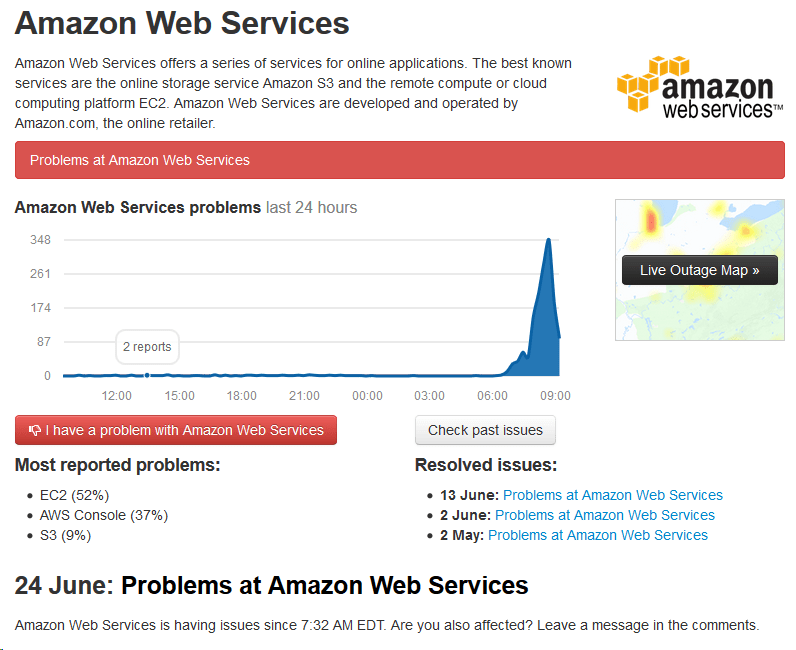
Bulldog Alert: Amazon Web Services was having connectivity issues today beginning at 7:32 AM EDT, confirmed by down detector. Issues have since been resolved and are blamed on an external internet provider. Even Amazon can have internet issues!

Let us know if you experience any connectivity issues with any of our hosted services. At this time all of our systems are running normally.

Amazon Web Services Having Outages This Morning

Two of the largest diagnostic labs: Quest & Labcorp were hacked. Was your medical data exposed?

Posted on
bulldogtech it support

Quest Diagnostics, as well as Lab Corp, two of the largest testing providers in the country, announced nearly 12+ million customers may have had personal, financial and medical information leaked due to an issue with one of its vendors.

Quest said it was notified that between Aug. 1, 2018, and March 30, 2019, that someone had unauthorized access to the systems of AMCA, a billing collections vendor.

“(The) information on AMCA’s affected system included financial information (e.g., credit card numbers and bank account information), medical information and other personal information (e.g., Social Security Numbers),” Quest said in the filing.

While customers’ broad medical information might have been compromised, Quest said AMCA did not have access to actual lab test results, and so therefore that data was not impacted. Read More at NBC

One day after Quest Diagnostics reported that nearly 12 million of its patients were potentially affected by a malicious breach of third-party bill collection vendor American Medical Collection Agency (AMCA), fellow clinical testing firm LabCorp acknowledged that roughly 7.7 million of its customers may be affected by the same incident.

Burlington, North Carolina-based LabCorp publicly disclosed the disturbing news yesterday in a Securities and Exchange Commission 8-K filing, warning that patient data it supplied to AMCA was exposed in the incident, which took place from Aug. 1, 2018 through March 30, 2019. Such information may include names, birth dates, addresses, phone numbers, dates of service, providers and unpaid balances.

Making matters worse, roughly 200,000 customers who paid LabCorp bills using AMCA’s web portal had their payment card information compromised, the LabCorp continued. According to the SEC filing, AMCA did not share the identities of these particular victims, but assured the diagnostics company that it had already begun to notify these individuals, and would offer them two years of identity protection and credit monitoring services.

Don’t Become a victim, let Bulldog protect your company’s data

How to Prevent Emails from Landing in Gmail’s Spam Folder

Posted on

Emails that land in the GMAIL spam folder are unpredictable. Sometimes they do get in there, sometimes they don’t. But, one of the simple tricks to prevent emails from landing in your spam folder is to ensure that you have the email address added in your GMAIL CONTACTS.

With Gmail, you can prevent this from happening by adding EMAIL FILTERS. This will help you to explicitly make a sender, or even with just the use of keywords to put filtered emails to your INBOX.

To do this, start by logging in to your GMAIL account > click the GEAR icon at the top right > then SETTINGS.

On the SETTINGS page, go to the FILTERS AND BLOCKED ADDRESSES tab then click CREATE NEW FILTER.

Now, let’s force GMAIL to not mark emails coming from [YOUR EMAIL ADDRESS] as SPAM. Let’s create a filter by setting [YOUR EMAIL ADDRESS] in the FROM field then proceed by clicking the CREATE FILTER WITH THIS SEARCH link.

Setup your filter upon your discretion but make sure to tick both the NEVER SEND IT TO SPAM and ALSO APPLY FILTER TO MATCHING MESSAGES check boxes. Click the CREATE FILTER button once you’re done.

Google implemented some security updates on their end over the past several weeks. We cannot modify anything on our side to ensure delivery, nor can we control delivery once messages leave our systems and are marked delivered by the receiving domain.

Optimum’s Servers Blocking Some Email Messages

Posted on

Beginning early this week optimum’s servers have been intermittently blocking some emails sent from our email system. If you are experiencing delivery issues when sending to your own optonline address, you must call tech support and request whitelisting of your domain.

Update 4/17/19 – Re-verified our systems are not on any of the internet blacklists, and contacted optimum support to try to get mail unblocked, still waiting for confirmation that they fixed the issue.